When someone gets better after using chlorine dioxide, it is easy to say: “Chlorine dioxide healed me.” Or: “Chlorine dioxide cured my problem.” Maybe there is another way to look at it. What if chlorine dioxide doesn’t actually do most of the healing? What if it simply helps remove something that was getting in the way? Then the real healer was there all along. Your body.
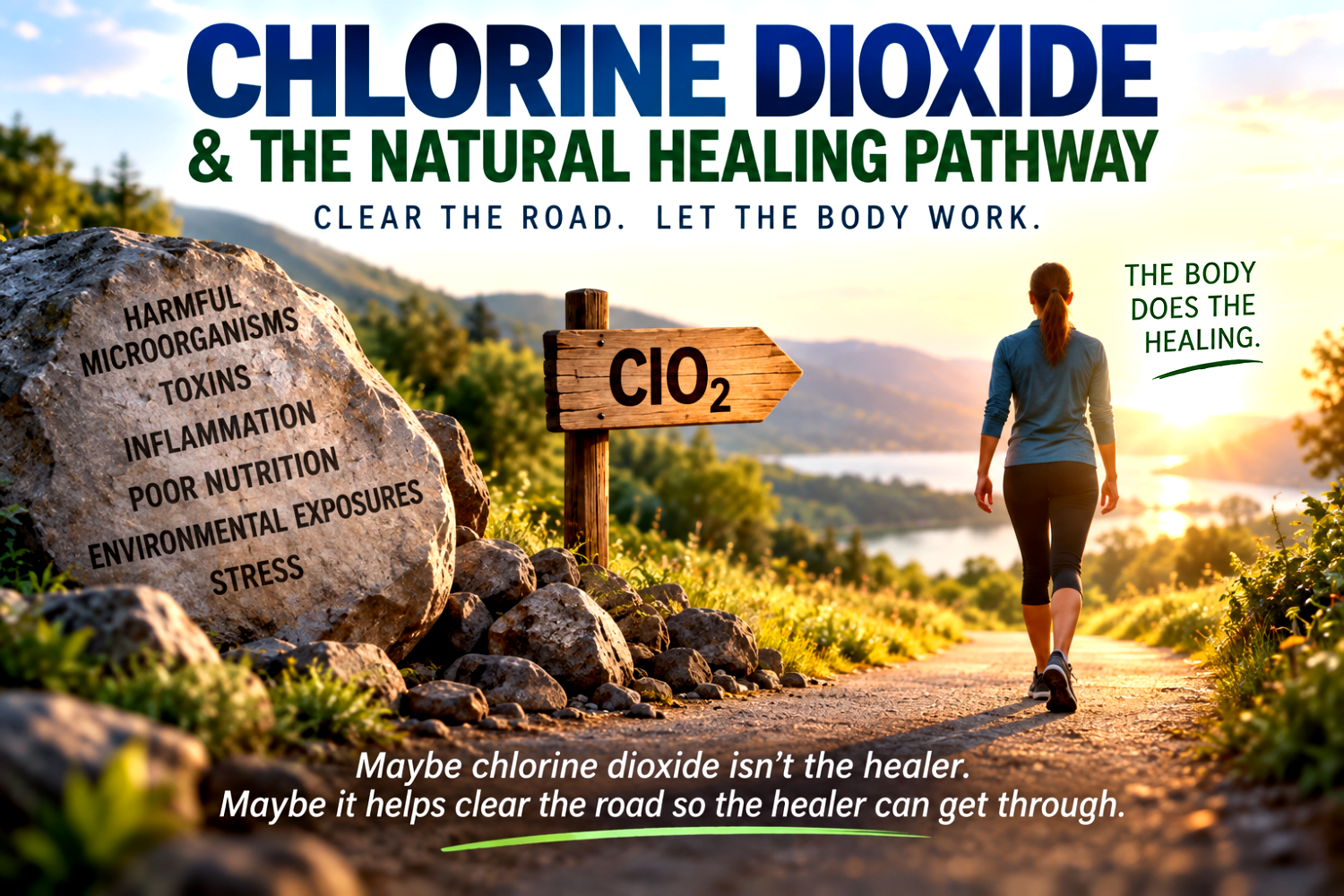
That may sound like a small difference. It isn’t. It changes the whole conversation.
Your Body Is Already a Healing Machine
Cut your finger. You don’t have to tell your body what to do. Within seconds, an amazing series of events begins. Blood vessels respond. Platelets gather. A clot forms. Immune cells arrive. Damaged material gets cleaned away. New tissue begins forming. Eventually, you have skin again. You didn’t consciously build it. Your body did.
Break a bone and something similar happens. Your body begins repairing it. Catch an ordinary infection and your immune system responds. Exercise a muscle and the body adapts. Go to sleep and thousands of maintenance jobs continue while you aren’t paying attention.
We tend to think about healing only when something goes wrong. Your body thinks about it all day long.
So Why Doesn’t the Body Always Heal?
That’s the interesting question. Imagine a road crew trying to repair a highway. They have workers. They have equipment. They know what they’re doing. But trucks are blocking the road. Garbage is everywhere. The asphalt hasn’t arrived. Half the workers haven’t slept. Someone keeps dumping more debris onto the highway. Eventually, it becomes difficult to repair the road.
Maybe the problem isn’t that the road crew forgot how to repair roads. Maybe there is too much getting in their way.
The human body isn’t a highway crew, of course, but the picture helps. Our natural repair systems need the right environment.
There Are a Lot of Moving Parts
The body needs raw materials.
- Protein.
- Fats.
- Vitamins.
- Minerals.
- Water.
- Oxygen.
It needs
- circulation to deliver those materials.
- movement
- rest
- working kidneys
- a working liver
- digestion.
It needs an immune system capable of recognizing problems without remaining unnecessarily activated all the time.
Then there are microorganisms.
Our bodies live with enormous communities of bacteria, fungi, viruses, and other microscopic life. Many are helpful. Some aren’t. And sometimes the balance changes.
Add environmental exposures, medications, stress, aging, injuries, infections, hormones, and genetics, and suddenly healing doesn’t look like one simple switch.
It looks like a giant network. Because it is.
Where Might Chlorine Dioxide Fit?
This is where my understanding of chlorine dioxide has changed. Chlorine dioxide is an oxidizer with powerful antimicrobial properties. Those properties explain why it has been used for decades to disinfect water and control microorganisms in other applications. But perhaps we sometimes give chlorine dioxide credit for doing considerably more than it actually does.
Imagine that somewhere along a long healing pathway there is an obstacle. Maybe chlorine dioxide affects that obstacle. That’s all.
- It doesn’t rebuild the bone.
- It doesn’t manufacture a new nerve.
- It doesn’t create muscle.
- It doesn’t make hormones.
- It doesn’t supply magnesium.
- It doesn’t exercise your legs.
- It doesn’t give you eight hours of sleep.
- It doesn’t magically repair every damaged cell.
Perhaps it performs one relatively small job upstream. And then something fascinating happens.
One Small Change Can Travel a Long Way
Picture a line of dominoes. Push the first one. It falls into the second. The second hits the third. Then the fourth. Soon something happens twenty feet away. If you only looked at the last domino, you might think: “Wow! That first domino knocked something over twenty feet away!”
Technically, it did. But it never touched it. There was a whole chain of events between them.
That may be a useful way to think about some of the remarkable reports surrounding chlorine dioxide.
Something changes upstream.
↓
Another system responds.
↓
Something else begins working better.
↓
The body gets resources where they’re needed.
↓
Repair becomes easier.
↓
Symptoms change.
And the person says: “Chlorine dioxide healed me.” Maybe. But perhaps something even more impressive happened.
The body healed itself after something stopped getting in its way.
We Have Already Seen Hints of This Idea
This way of thinking becomes particularly interesting when we look at seemingly unrelated health problems.
Take osteoporosis. The problem appears to be in the bones. But bone health can be affected by digestion, nutrient absorption, hormones, inflammation, physical activity and the intestinal microbiome.
So something happening in the gut could eventually affect something happening in a hip.
Now consider Parkinson’s disease. The obvious problem appears to be in the brain. Yet researchers are increasingly investigating connections among the intestines, microbiome, nervous system, inflammation, and brain—the gut-brain axis.
Once again: Something happening here may affect something happening over there.
The body is connected. We divided it into departments because that makes medicine easier to study. The body never got the memo.
Maybe We Should Follow the Pathway
This gives us a different way to investigate reports involving chlorine dioxide. Instead of immediately asking: “How did chlorine dioxide heal that?” ask: “What changed first?” That is a much better question.
- Did digestion change?
- Did an infection resolve?
- Did microbial populations change?
- Did inflammation change?
- Did nutrient absorption improve?
- Did sleep improve?
- Did pain decrease enough that the person started moving again?
- Did movement improve circulation?
- Did better circulation improve something else?
Suddenly we aren’t looking for one magical answer. We’re following a pathway.
The Body Needs Raw Materials
Removing obstacles is only half the story. You can clear every truck off our imaginary highway, but the road crew still needs asphalt. Your body also needs building materials.
This is one reason nutrition matters.
- Minerals matter.
- Protein matters.
- Healthy fats matter.
- Water matters.
- Oxygen matters.
Someone could theoretically remove an obstacle and still have poor healing because the body doesn’t have what it needs to complete the job.
This helps explain why two people can do exactly the same thing and get completely different results.
One person’s healing machinery may be ready to go. Another person’s may be missing three other pieces.
Movement Is Part of Healing Too
Our bodies were built to move. Movement helps circulation. Muscles respond to being used. Bones respond to mechanical loading. Balance improves through practice. The heart adapts to activity. Even digestion can respond to movement. Sometimes an improvement in one area lets someone become more active. Then activity creates another improvement. Which creates another.
Another set of dominoes begins falling.
This is why it can become surprisingly difficult to identify exactly what caused someone to get better. Maybe that’s okay.
Sometimes the important thing is that the healing pathway started moving again.
Cleanliness Doesn’t Mean Sterility
There’s another distinction worth making. If microorganisms sometimes contribute to illness, it might seem logical to eliminate as many microorganisms as possible. But that’s not how a healthy body works.
We need microorganisms. Our intestines contain vast microbial communities that participate in digestion, metabolism, and immune function.
So the goal shouldn’t necessarily be: Kill everything. A better goal may be: Help create an environment in which healthy balance becomes easier to maintain.
That distinction becomes especially important when thinking about something antimicrobial.
Can Too Much of a “Good Thing” Become Too Much?
This may be one of the most important questions chlorine dioxide enthusiasts can ask.
If something seems helpful, human nature says: More must be better. But biology rarely works that way.
Exercise is good. Exercise every waking hour isn’t.
Water is necessary. Too much water can be dangerous.
Sunlight supports important biological processes. Too much sunlight burns us.
Even oxygen—the thing we cannot live without—can cause injury at excessive exposures.
So, if chlorine dioxide helps because it performs some useful upstream job, another question naturally follows: How do we know when that job is finished?
That question deserves attention.
- Perhaps some people benefit from short periods of use.
- Perhaps others respond differently.
- Perhaps there are circumstances in which continuing indefinitely adds nothing.
- And perhaps there could be circumstances in which continuing to push the system becomes counterproductive.
Those aren’t arguments against chlorine dioxide. They are arguments for paying attention.
Listen to the Body
This is one part of Herb Roi Richards‘ approach that I particularly appreciate.
Pay attention.
Don’t simply follow something because someone wrote it on a piece of paper. Notice what happens.
- How do you feel?
- What changed?
- What didn’t?
- Are you improving?
- Are you getting worse?
- Did something unexpected happen?
Your body communicates through symptoms, energy, digestion, sleep, pain, movement, appetite, and hundreds of other signals.
Listening doesn’t mean every sensation tells us exactly what is happening. It means don’t ignore the information.
Experiment With Caution and Reverence
There is something I like about the word reverence here. Your body isn’t a chemistry set that you need to conquer. It’s an extraordinarily complicated living system that has been keeping you alive every second since before you were born. Treat it accordingly.
- Change something.
- Observe.
- Learn.
Don’t assume that because something helped someone else, your body will respond exactly the same way. And don’t become so attached to one idea that you stop noticing everything else.
Use Your Resources
Sometimes listening to your body means realizing: I don’t understand what’s happening. That’s useful information too.
Talk with someone who knows more. That might be a physician. A specialist. A pharmacist. A nutrition professional. A physical therapist.
Or another qualified healthcare professional who understands the particular problem you’re facing.
Tests can also provide information that feelings alone cannot.
We have resources. Use them.
You don’t lose your independence by gathering more information. You gain more information with which to make your own decisions.
Don’t Fall in Love With the Hammer
There’s an old saying: If all you have is a hammer, everything starts looking like a nail. Chlorine dioxide can become the hammer.
Someone experiences a dramatic improvement, and suddenly chlorine dioxide becomes the answer to everything. But what if the lesson is bigger than chlorine dioxide?
Maybe the lesson is: Find what’s interfering with healing.
Reduce unnecessary obstacles. Give the body the materials it needs.
- Move.
- Rest.
- Eat.
- Hydrate.
- Pay attention to microbial balance.
- Reduce harmful exposures.
- Support circulation.
- Investigate persistent problems.
- Use appropriate medical resources.
And don’t assume yesterday’s solution must become tomorrow’s lifelong ritual.
Chlorine Dioxide May Be the First Domino
This is becoming my preferred way of thinking about chlorine dioxide.
Maybe it isn’t the construction crew. Maybe it doesn’t deserve credit for every repair that happens afterward. Perhaps sometimes it is simply: the first domino.
Something changes. That allows something else to change. That frees another process. That process affects another. And somewhere much farther downstream, the body finally gets an opportunity to do something it has been trying to do all along.
Heal.
That’s a very different picture from: “Take chlorine dioxide. Chlorine dioxide cures disease.” And strangely enough, I think it’s a much more exciting picture. Because now chlorine dioxide isn’t the hero.
The human body is.
Chlorine dioxide may simply be one of many tools that can sometimes help clear the pathway. And once we understand healing that way, an entirely new question opens before us:
What else can we do to make the pathway easier to travel?
- Nutrition.
- Movement.
- Sleep.
- Clean water.
- Healthy relationships.
- Sunlight.
- Fresh air.
- Minerals.
- Appropriate medical care.
- Reducing harmful exposures.
- Taking care of the gut.
- Managing stress.
- Giving the body time.
There may be hundreds of possibilities. Which means we don’t have to become attached to any one of them.
- We can remain curious.
- We can experiment thoughtfully.
- We can use our resources.
And above all, we can develop a little more respect for the astonishing healing machine that has been quietly working inside us all along.
Informational Notice
This article presents a wellness philosophy and an exploratory way of understanding reports surrounding chlorine dioxide. Chlorine dioxide is an oxidizing chemical and is not clinically established as a treatment or cure for disease. Its established uses and safety limits depend on concentration and route of exposure. Significant, persistent, or worsening symptoms deserve appropriate healthcare evaluation.