Categories
Research

Food Combining and Digestion: Investigating Unconventional Scientific Theories

Some of the most interesting investigations begin when someone notices something that doesn’t seem to fit the prevailing explanation.
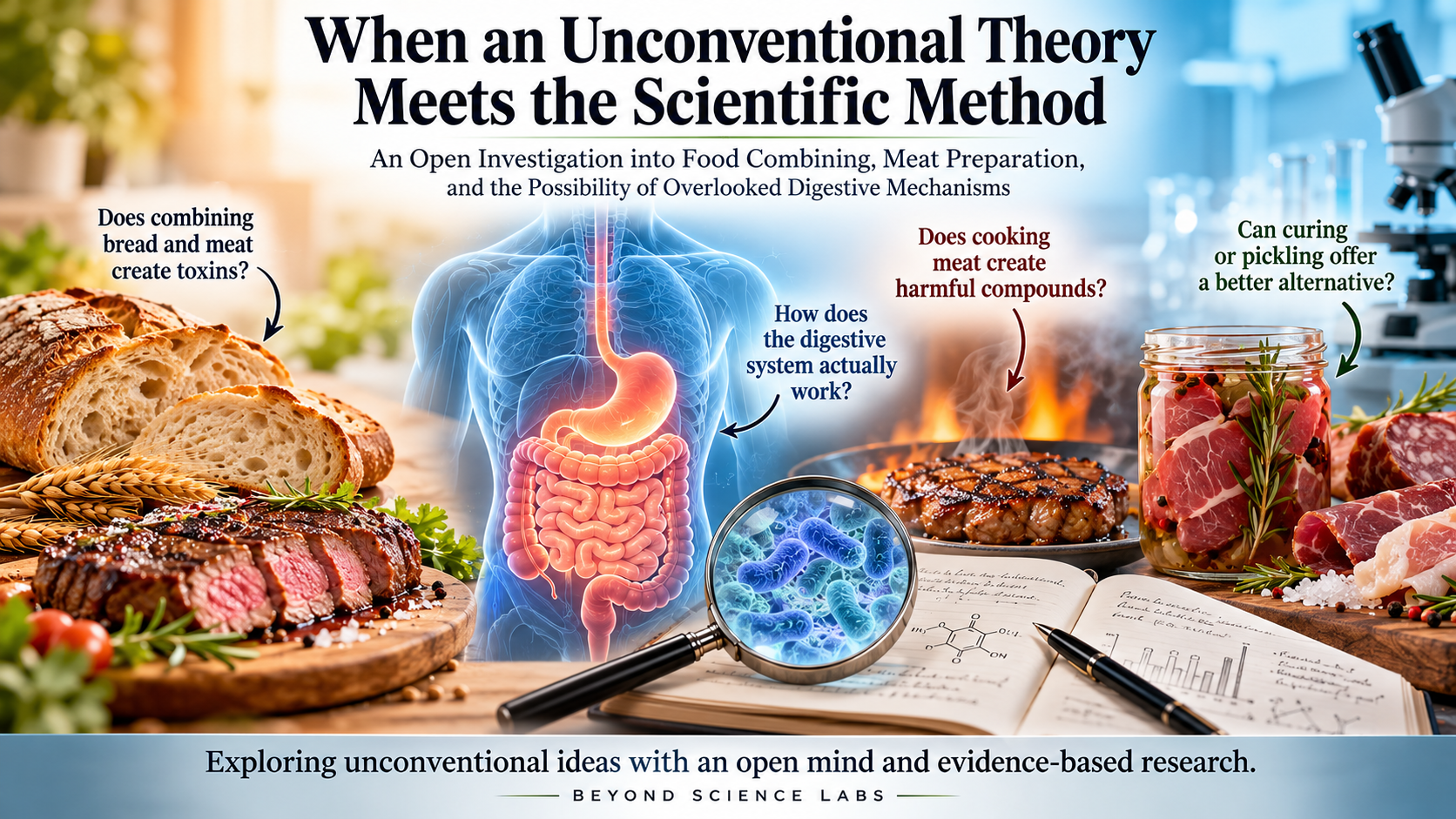
An individual changes a longstanding dietary habit and notices an improvement in energy. Someone else observes that certain foods seem to produce digestive discomfort when eaten together, but not when eaten separately. Another investigator questions whether a traditional method of preparing food might preserve beneficial qualities that modern cooking methods alter. These observations may lead to unconventional theories.

Science Doesn’t Begin With an Answer. It Begins With a Question.

Some theories will eventually be supported by evidence. Others will require substantial revision. Still others may prove incorrect while pointing toward an entirely different discovery.

At Beyond Science Labs, we believe these possibilities deserve thoughtful consideration.

Scientific investigation is not a contest between conventional thinking and unconventional thinking. It is a process of identifying what can be observed, proposing explanations, and determining which explanations best account for the evidence.

The objective is not to protect an established belief.

Nor is it to protect a new one.

The objective is to discover what is actually happening.

A Case Study: Three Dietary Hypotheses Submitted for Review

For this discussion, we will examine three related propositions submitted for preliminary consideration.

The first suggests that carbohydrate-rich foods and protein-rich foods may be processed through different digestive mechanisms, and that combining certain foods, such as bread and meat, could produce undesirable substances during digestion.

The second proposes that cooking meat may transform its proteins and other constituents in ways that introduce harmful compounds.

The third suggests that traditional preservation methods, including curing, pickling, and fermentation, may offer advantages over conventional heat preparation.

These propositions are related, but they are not identical.

Each involves different biological or chemical processes. Consequently, each must be evaluated independently before attempting to construct a unified explanation.

This distinction is important.

A finding that supports one proposition does not automatically establish the others.

Investigation One: Are There Two Digestive Systems?

The idea that the human body processes different classes of food through distinct digestive mechanisms has an identifiable physiological foundation.

Carbohydrates, proteins, and fats do not undergo precisely the same chemical transformations.

Starch digestion begins with enzymes such as salivary amylase. Protein digestion involves stomach acid, pepsin, and additional enzymes in the small intestine. Fat digestion depends heavily on bile and pancreatic lipase.

These processes occur in different environments and involve different chemical reactions.

An investigator observing these distinctions might reasonably ask whether certain combinations of food interfere with optimal digestion.

That is a legitimate research question.

However, the existence of different digestive mechanisms does not establish the existence of two separate digestive systems.

Human digestion normally coordinates the processing of mixed meals containing carbohydrates, proteins, and fats.

The stomach, pancreas, liver, gallbladder, and intestines work together rather than requiring a person to select only one nutrient category at a time.

Where the Investigation Becomes Interesting

Suppose an individual reports feeling better after separating protein-rich and carbohydrate-rich meals.

There are several possible explanations.

Perhaps the separated meals are smaller. Perhaps they contain less fat. Perhaps the person eats more slowly, consumes fewer calories, or avoids a particular ingredient that previously caused discomfort.

Another possibility is that individual differences in gastrointestinal motility, digestive tolerance, or metabolic responses influence the experience.

And perhaps there are additional mechanisms not yet adequately considered.

Rather than assuming one explanation, a careful investigator would identify the competing possibilities and look for ways to distinguish them.

The original observation need not be discarded simply because its first proposed explanation remains unproven.

An observation and the explanation assigned to it are two different things.

Investigation Two: Does Combining Bread and Meat Produce Harmful Substances?

This hypothesis introduces a more specific claim.

It is no longer simply that someone feels better when eating foods separately. The proposition is that combining certain foods creates harmful substances during digestion.

That is a testable chemical and physiological assertion.

To investigate it, we would first need to define what is meant by harmful.

Are we discussing excess gas? Undigested food? Changes in intestinal fermentation? A measurable toxic compound? An inflammatory response? Or a clinically significant disease process?

These are different outcomes.

For example, intestinal bacteria routinely ferment certain undigested carbohydrates, producing gases and short-chain fatty acids.

Fermentation is not automatically harmful. Some fermentation products contribute positively to intestinal health, while excessive gas production may cause discomfort in susceptible individuals.

Similarly, the breakdown of dietary proteins can produce various microbial metabolites. Their significance depends on the compounds involved, their concentrations, and the circumstances in which they are produced.

A researcher cannot determine whether a food combination is poisonous without identifying the substance, measuring exposure, and demonstrating a relevant harmful effect.

What Would a Fair Comparison Look Like?

We might compare meals containing the same total calories, protein, carbohydrate, and fat, but consumed in different combinations or at different times.

We would account for meal size, eating speed, food preparation, and individual digestive conditions.

We could then examine reported symptoms alongside objective measurements, such as gastric emptying, relevant metabolites, and other validated markers.

The question would not be whether one eating pattern feels more natural.

The question would be whether the proposed combination consistently produces a measurable adverse effect beyond the effects of its individual ingredients.

Current understanding of digestive physiology does not establish that bread and meat become poisonous when eaten together.

Nevertheless, the broader question of how meal composition affects digestion, symptoms, and metabolic responses remains a worthwhile field of study.

Investigation Three: Does Cooking Meat Create Harmful Compounds?

This proposition has a particularly interesting scientific foundation.

Heat changes food.

It denatures proteins, alters texture, affects water content, and can produce new chemical compounds.

Some changes improve digestibility or food safety.

Others may be undesirable.

Research has identified heterocyclic amines and polycyclic aromatic hydrocarbons associated with certain high-temperature meat preparation methods.

These compounds are of interest because some demonstrate mutagenic or carcinogenic activity in experimental settings.

Their formation depends on several factors, including temperature, duration, cooking method, and exposure to smoke or direct flame.

This supports a narrower proposition: some cooking methods can produce potentially harmful compounds, particularly when meat is subjected to intense heat or charring.

It does not establish that all cooked meat becomes poisonous.

Gentle heating, boiling, steaming, roasting, and high-temperature grilling can produce substantially different chemical results.

A useful investigation would therefore compare cooking methods rather than placing all cooked meat into a single category.

Cooking Also Changes Microbiological Risk

Heat preparation has another important function.

Proper cooking can substantially reduce pathogenic microorganisms in meat.

This creates a genuine scientific tradeoff.

One method of preparation may reduce microbiological hazards while producing more heat-related compounds than another.

The question becomes whether preparation techniques can reduce both kinds of exposure.

That is a more productive investigation than assuming that either all cooking is harmful or all cooking is beneficial.

Investigation Four: Can Curing, Pickling, or Fermentation Offer a Better Alternative?

Traditional food preservation methods deserve serious scientific attention.

Long before modern refrigeration, communities developed methods of preserving meat using salt, drying, acidity, smoke, and fermentation.

These methods were not merely culinary preferences. They were practical responses to spoilage and food scarcity.

Modern food science has identified several mechanisms through which preservation works.

Salt can reduce available water needed for microbial growth. Acidification can inhibit certain microorganisms. Fermentation can alter the chemical environment of a food. Drying reduces moisture availability.

When properly designed and controlled, these processes can contribute to food safety and preservation.

However, their effectiveness depends on specific conditions.

Not all curing methods are equivalent.

Not all pickling methods achieve the same acidity.

And the presence of salt or vinegar does not automatically establish that raw meat is safe to consume.

Certain pathogens may survive inadequate preservation procedures, and some preservation processes can introduce additional chemical concerns.

The scientific question is therefore not simply whether traditional preservation is better than cooking.

It is:

Which preparation methods, under which controlled conditions, best preserve desirable nutritional qualities while minimizing microbiological and chemical hazards?

That question leaves considerable room for investigation.

Following the Evidence Without Protecting the Hypothesis

At this stage, we can separate the original propositions into components.

Proposed idea What is already supported What remains unestablished
Different foods require different digestive mechanisms Proteins, fats, and carbohydrates undergo different enzymatic processes That humans have two separate digestive systems requiring food separation
Combining bread and meat creates poison Meal composition can influence digestion and individual tolerance That this combination produces a specific harmful substance merely because the foods are combined
Cooking meat produces undesirable chemicals Certain high-temperature methods produce potentially harmful compounds That all cooking makes meat poisonous
Curing or pickling offers advantages Properly controlled preservation can inhibit microorganisms and change food properties That these methods universally outperform safe cooking or reliably eliminate raw-meat hazards

This is not a verdict on the investigator who submitted the ideas.

It is a working map of the investigation.

A hypothesis may contain a valid observation, an incomplete mechanism, and an overly broad conclusion simultaneously.

Our task is to separate those components.

A Practical Model for Independent Investigation

A useful scientific investigation follows a series of questions.

First: What exactly was observed?

Describe the experience without adding an explanation prematurely.

For example: An individual reports less digestive discomfort when eating protein-rich and carbohydrate-rich foods separately.

Second: What explanation is being proposed?

State the mechanism clearly enough that it could be tested.

For example: Combining these foods changes digestion in a way that increases the production of a particular harmful compound.

Third: What other explanations are possible?

Consider meal size, ingredients, timing, digestive disorders, food preparation, and other relevant variables.

Fourth: What evidence would distinguish the explanations?

Determine which measurements, comparisons, or existing research could reveal whether the proposed mechanism is operating.

Fifth: What result would cause us to revise the hypothesis?

This may be the most important question of all.

A scientific hypothesis becomes more useful when its author can identify what evidence would count against it.

Without that possibility, an idea may remain a personal belief, but it becomes difficult to investigate scientifically.

Sixth: What have we learned, even if the original explanation changes?

An unexpected result can be the beginning of another investigation.

Science advances when investigators remain willing to follow those results.

The Value of Being Willing to Change Your Mind

Independent investigators often devote years to observing phenomena that others overlook. Their persistence can be valuable. So can their willingness to challenge accepted explanations. But independence is not measured by how firmly someone resists conventional science.

It is measured by how freely someone follows the evidence, including evidence that challenges their own conclusions.

An investigator might begin with the belief that combining certain foods produces a harmful chemical reaction.

Further investigation might reveal that the reaction does not occur as proposed, but that meal size, cooking temperature, intestinal motility, or individual digestive conditions explain the original observation.

That would not necessarily represent a failed investigation. It could represent a successful one.

The investigator would have moved from a broad theory toward a more precise understanding. And precision is progress.

Where This Investigation Stands

The dietary propositions examined here raise several legitimate questions about digestive physiology, food chemistry, preparation methods, and individual nutritional responses.

Some components are supported by established scientific knowledge. Others remain speculative or conflict with current evidence.

The present review does not report new laboratory experiments or establish a new digestive theory.

It identifies the questions, distinguishes the mechanisms involved, and suggests where further investigation could be most productive.

Importantly, uncertainty should not be confused with equal support for every possibility. A proposed explanation must still account for existing evidence and withstand appropriate testing.

For now, there is insufficient evidence to conclude that combining bread and meat creates poison or that raw, cured, or pickled meat is generally safer than properly cooked meat.

There is, however, a sound basis for investigating how food combinations affect individual digestion, how different cooking methods alter meat chemistry, and how controlled preservation techniques compare with other preparation methods.

Those are worthwhile questions in their own right.

An Open Invitation

Beyond Science Labs welcomes unconventional observations, emerging hypotheses, and thoughtful challenges to established explanations.

We also welcome evidence that causes an investigator to revise an earlier position.

The purpose of inquiry is not to defend an answer we already possess. It is to discover something we did not previously understand.

A theory is not diminished when it is refined by evidence. It becomes more useful.

And sometimes the most important discovery begins when an investigator says:

That’s interesting. I thought I understood what was happening. Let’s look again.

Beyond Science Labs | Independent Research Review

Research status: Preliminary literature-based evaluation of submitted hypotheses. No independent laboratory experiments are reported in this article.

Educational notice: This discussion is not a recommendation to consume raw or inadequately preserved meat. Foodborne pathogens can cause serious illness, and preservation methods must be validated for safety. Readers should follow established food-safety practices.

 

Categories
Articles

When a Natural Remedy Works Don’t Waste the Opportunity Window

A natural health practitioner once told me about a client who was gravely ill with lung cancer. According to the practitioner, the man was essentially on his deathbed. He was also smoking about three packs of cigarettes a day.

The practitioner introduced him to pau d’arco, a traditional herbal preparation. What happened medically can’t be reconstructed from the story alone, and it would be inappropriate to conclude from one account that pau d’arco treated or cured his cancer.

But something remarkable apparently happened in this man’s life. He recovered enough to get up, function and go on living.

Years later, the practitioner happened to run into him. Naturally, he wanted to know how the man was doing. The man enthusiastically reported that he was still taking pau d’arco every day. That sounded encouraging.

Then he added that he was now smoking four packs of cigarettes a day. Ugh.

There may be an entire lesson in natural alternative practice contained in that one story. The practitioner believed he had helped give this man a new lease on life. The man apparently believed he had found something that enabled him to keep living his old one.

Those are two very different things.

When Something Works

Natural Alternative Specialists hear extraordinary stories.

  • Someone changes their diet and their arthritis improves.
  • Someone takes an herb and an inexplicable digestive problem disappears.
  • Someone begins using magnesium and starts sleeping again.
  • Someone tries a traditional preparation and reports that chronic pain they have lived with for years suddenly becomes manageable.
  • Someone undergoes acupuncture and begins moving differently.
  • Someone makes an enormous recovery and attributes it to garlic, castor oil, iodine, sulfur, fermented foods, an herbal tea or something most conventional practitioners wouldn’t have thought to investigate.
  • Sometimes the explanation is obvious.

Frequently, it isn’t. And occasionally the client’s conclusion becomes: “It cured me.”

That may be exactly how the experience feels. But there is another possibility worth considering.

Maybe something opened a window.

Cure and Opportunity Are Not the Same Thing

Imagine someone who has been chronically ill for years. Their situation might involve several interacting problems:

  • poor sleep,
  • little physical activity,
  • chronic inflammation,
  • metabolic dysfunction,
  • poor nutrition,
  • pain,
  • digestive problems,
  • stress,
  • muscle loss,
  • and progressively declining function.

Now something changes.

  • Perhaps pain decreases dramatically.
  • Perhaps digestion improves.
  • Perhaps blood glucose improves.
  • Perhaps energy returns.
  • Perhaps inflammation decreases.
  • Perhaps the person finally sleeps.

Whatever happened, the person suddenly feels substantially better.

The temptation is to draw a straight line:

I had the disease.

↓

I used the remedy.

↓

I feel better.

↓

The remedy cured the disease.

But biological systems don’t necessarily work in straight lines.

Another possibility is:

Something changed.

↓

A dysfunctional cycle was interrupted.

↓

Other biological systems responded.

↓

Symptoms improved.

↓

Function returned.

↓

A window opened.

The remedy may have been important. But the window may be even more important.

The Body Is a Network, Not a Collection of Spare Parts

For a long time, it has been easy to think about the human body mechanically.

  • The knee hurts. Look at the knee.
  • The liver is malfunctioning. Look at the liver.
  • The brain is producing symptoms. Look at the brain.
  • The back hurts. Look at the spine.

There is tremendous value in that approach. Modern medicine has become remarkably good at repairing, stabilizing, and even replacing damaged structures.

  • A destroyed hip can be replaced.
  • An unstable spine can be stabilized.
  • A damaged shoulder can be reconstructed.
  • A failing organ can sometimes even be transplanted.

Thank goodness. But another question belongs alongside the mechanical one:

What was happening throughout the biological system before the part failed?

Modern research is increasingly revealing communication between systems that once appeared remarkably distant from one another.

  • The gut communicates with the immune system.
  • The immune system communicates throughout the body.
  • Microbial metabolites can enter circulation.
  • Metabolism affects inflammation.
  • Inflammation affects tissues.
  • Movement affects metabolism.
  • Pain affects movement.
  • Sleep affects immune and metabolic function.

And all of them can influence one another.

The human body isn’t simply a collection of independent parts. It is a network.

Then Along Came the Microbiome

Few areas of modern research illustrate this interconnectedness better than the intestinal microbiome.

Scientists now investigate relationships described with terms such as:

  • gut-brain axis
  • gut-liver axis
  • gut-bone axis
  • gut-joint axis
  • gut-spine axis

and even the

  • gut-spinal cord axis.

These names don’t mean scientists have demonstrated that every disease begins in the gut. They haven’t.

They describe something more interesting:

Biological events occurring in one place can influence biological conditions somewhere surprisingly distant.

Microbial metabolites, intestinal-barrier function, immune signaling, and metabolic pathways are among the mechanisms being investigated.

That raises an intriguing question for people working in traditional and natural medicine.

What If We Have Sometimes Been Explaining the Right Observation the Wrong Way?

Traditional remedies have accumulated over hundreds or sometimes thousands of years. Different cultures developed completely different explanatory systems.

  • One healer might say an herb cleanses the blood.
  • Another might say it strengthens the liver.
  • Another might describe energy moving differently.
  • Another might speak about removing toxins.
  • Another might describe balancing the body.

A modern researcher might eventually discover that a plant compound interacts with intestinal microorganisms, which transform it into another compound, which influences immune signaling, which changes an inflammatory process somewhere else.

Does that prove the traditional explanation? No.

Does it mean the original observation was worthless? Not necessarily.

There is a fascinating third possibility:

People may sometimes have observed the end of a biological chain without possessing the scientific tools necessary to see its beginning or middle.

That possibility should make Natural Alternative Specialists extremely curious. Not gullible. Curious.

FMT Gives Us a Remarkable Example

Fecal microbiota transplantation (FMT) is an unusually dramatic demonstration of the principle.

FMT deliberately changes the intestinal microbial environment by transferring screened donor microbiota. Its established medical use is primarily associated with recurrent Clostridioides difficile infection, but researchers are investigating microbiome manipulation in numerous other conditions. And some experimental findings are fascinating precisely because the outcomes don’t necessarily occur in the intestine.

Researchers have investigated microbiome interventions in metabolic disease, neurological disorders, liver disease and even recovery following spinal-cord injury.

That does not mean FMT cures all those conditions. It means something more fundamental.

Changing an upstream biological environment can sometimes produce measurable changes downstream.

And once we understand that principle, some old natural-health stories become considerably more interesting research questions.

Maybe It Wasn’t “The Arthritis Herb”

Suppose someone’s grandmother took a particular plant preparation whenever her joints became painful. It helped. The family concludes: “Grandma’s herb treats arthritis.”

Maybe. But imagine another possibility.

  • Perhaps compounds in the plant altered microbial metabolism.
  • Perhaps microorganisms transformed compounds in the plant into something different.
  • Perhaps intestinal-barrier function changed.
  • Perhaps an immune pathway changed.
  • Perhaps inflammatory signaling changed.

And eventually: Grandma’s joints hurt less.

Grandma couldn’t possibly have known the mechanism. She knew what mattered to her. She could get out of the chair again.

That observation shouldn’t automatically become proof that the herb treats arthritis. But neither does it need to be thrown away. It becomes a clue.

Natural Alternative Specialists Are Investigators

This is where our role becomes important.

A Natural Alternative Specialist doesn’t have to choose between: “That’s nonsense.” and: “That’s a miracle cure.”

There is an enormous territory between those two conclusions. It’s called: Let’s find out what happened.

  • What changed?
  • When did it change?
  • What changed first?
  • What changed next?
  • Did pain change?
  • Did sleep improve?
  • Did digestion change?
  • Did inflammation change?
  • Did blood glucose change?
  • Did mobility increase?
  • Did laboratory measurements change?
  • Did imaging change?
  • Did medication requirements change under appropriate medical supervision?
  • Did something else change at exactly the same time?

And perhaps most importantly:

  • Did the improvement last?

That’s investigation.

Don’t Fall in Love With Your Explanation

This may be especially important for natural practitioners. Suppose someone uses your favorite remedy and experiences an extraordinary improvement.

It’s tempting to say: “I knew it!” But perhaps you don’t know it yet.

The outcome may be real, while your explanation is wrong. That’s not failure. It’s an invitation.

Wayne Rowland was intensely interested in reproducibility. Herb Roi Richards collected witness reports and looked for similarities among people reporting comparable outcomes.

Those are understandable early steps in investigation. Repeated observations can reveal patterns.

But once a pattern appears, the next step isn’t necessarily: We’ve proven it. It’s: Now we have something worth testing.

That distinction protects both the practitioner and the client.

Relief Can Be Profound Without Being a Cure

This may be one of the most useful distinctions we can teach our clients.

  • Suppose someone’s chronic pain drops dramatically. That matters.
  • Suppose their mobility returns. That matters.
  • Suppose they sleep normally for the first time in years. That matters.
  • Suppose a metabolic measurement improves dramatically. That matters.

We don’t diminish an improvement by refusing to call it a cure.

In fact, we may discover something more useful. Because if we recognize the improvement as a window of opportunity, our next question becomes:

What Can We Do Now That We Couldn’t Do Before?

Someone couldn’t exercise because every movement hurt. Now the pain has diminished.

There’s the window. Begin moving appropriately.

Someone’s metabolic health improves.

There’s the window. Improve the diet, activity, sleep and other modifiable conditions that may have contributed to the original deterioration.

Someone finally begins sleeping.

There’s the window. Let the body recover while also investigating what repeatedly disrupted sleep.

Someone’s digestive symptoms settle.

There’s the window. Build a sustainable nutritional pattern rather than immediately returning to everything that preceded the problem.

The apparent remedy may have opened the door. It doesn’t make the client walk through it.

When Relief Becomes Permission

And that brings us back to the gentleman with the cigarettes. He apparently experienced a tremendous second chance. But he seems to have interpreted his experience differently from his practitioner.

Instead of: “Something extraordinary happened. What should I change so I never end up there again?” his behavior suggested something closer to: “I found something that lets me keep doing what I was doing.”

Three packs became four.

This illustrates a surprisingly important danger.

A successful intervention can sometimes reinforce the behavior that contributed to the problem.

  • “I can eat this way because I know how to bring my blood sugar back down.”
  • “I don’t need to strengthen my back because I know what makes the pain disappear.”
  • “I don’t have to change anything because I’ll just do another round.”

The remedy becomes a rescue mechanism.

The person may become psychologically dependent upon the availability of the rescue without ever addressing the conditions that repeatedly create the need for rescue.

Diabetes Makes the Pattern Easy to See

Imagine someone with Type 2 diabetes who makes some change, natural, conventional, or both, and their glucose control improves substantially.

They feel wonderful. Their numbers improve. They announce: “My diabetes is gone!”

  • Perhaps they’ve achieved remission.
  • Perhaps medication is contributing.
  • Perhaps weight changed.
  • Perhaps diet changed.
  • Perhaps something affected glucose metabolism.
  • Perhaps several things happened simultaneously.

The responsible response isn’t to argue over terminology. It’s to recognize the opportunity. Because if the person immediately returns to the same combination of behaviors and biological pressures that contributed to their metabolic dysfunction, those improvements may not persist.

And then comes the familiar refrain: “No problem. I’ll just do the thing again.”

That may work again. Or it may not. But even if it does, something valuable may have been squandered.

A New Lease on Life

That’s why I keep returning to the phrase new lease on life. A lease isn’t ownership. It’s an opportunity to occupy something for another period under certain conditions.

Maybe some interventions do something similar.

  • Perhaps they don’t permanently eliminate the underlying problem.
  • Perhaps they interrupt something.
  • Perhaps they reduce one contributor.
  • Perhaps they change an environment.
  • Perhaps they improve one system enough that several other systems begin responding.
  • Perhaps they simply provide enough relief that the person can finally participate in their own recovery.

Whatever happened, the result may be: More time. More function. More options.

That’s extraordinarily valuable.

But: A new lease on life isn’t terribly useful if we use it to renegotiate the terms of the old lease.

Before We Replace the Part

This idea also raises an intriguing question about degenerative conditions. Modern medicine can do astonishing things when biological structures fail.

We can

  • Replace hips.
  • Replace knees.
  • Replace shoulders.
  • Stabilize vertebrae.
  • Repair arteries.
  • Replace heart valves.
  • Transplant organs.

These procedures save and transform lives. But long before a joint reaches the point of mechanical failure, there may be years of changing biology.

  • Inflammation
  • Metabolic dysfunction.
  • Muscle loss.
  • Reduced activity.
  • Poor circulation.
  • Nutritional inadequacy.
  • Immune changes.
  • Microbial changes.
  • Sleep disruption.
  • Pain.
  • And feedback loops among them.

So perhaps another important natural-health question is:

Before we replace the damaged part, are there modifiable conditions surrounding that part that we could investigate?

Sometimes the answer will be no. Sometimes structural damage has progressed too far. Sometimes surgery is exactly what someone needs. But wouldn’t we rather investigate that question before reaching the irreversible endpoint?

This Is Not “Try Anything”

There is an important difference between experimentation and recklessness.

Natural Alternative Specialists should not encourage clients to throw random substances at serious disease while delaying necessary diagnosis or treatment.

  • Some conditions are emergencies.
  • Some neurological deficits can become permanent if treatment is delayed.
  • Some infections progress rapidly.
  • Some cancers require timely intervention.
  • Some structural problems cannot safely wait.

Experimentation should be proportional to risk.

That means considering:

What do we know about the intervention?

What are its risks?

What could interact with medications?

What objective measurements can we follow?

What happens if we wait?

What would tell us to stop?

When should another qualified professional be involved?

That isn’t surrendering natural health to conventional medicine. That’s being a good investigator.

You Can’t Want It More Than They Do

And eventually we arrive at one of the hardest lessons in practice.

  • You can research.
  • You can investigate.
  • You can introduce possibilities.
  • You can help someone identify patterns.
  • You can help create a window.
  • You can stand beside the open door.

But you cannot make someone walk through it.

A practitioner may see someone’s remarkable improvement and think:

“Look what is possible now!”

The client may think:

“Great. Now I can go back to exactly what I was doing.”

That’s their choice. But part of our job is making sure they understand that they have a choice.

Don’t Just Celebrate the Improvement

When something appears to work remarkably well, don’t automatically conclude that your work is finished. That may be when the most important work begins.

Ask:

  • What changed?
  • What can we measure?
  • What became possible?
  • What still needs attention?
  • What contributed to getting here?
  • What could send us back?
  • What can we change while this window is open?

And:

  • What Changed First?

That question keeps appearing because it forces us to stop arguing about explanations and start investigating sequences.

Perhaps someday we will discover that certain traditional interventions influence biological pathways nobody suspected. Others may turn out to have worked for completely different reasons than practitioners believed. Some won’t survive careful investigation at all.

That’s okay.

Natural Alternative Specialists don’t need every traditional claim to be true. We need to be willing to investigate what happens.

The Remedy Doesn’t Have to Be the Hero

Maybe this is the biggest lesson.

  • The herb doesn’t always have to cure the disease.
  • The supplement doesn’t have to rebuild the organ.
  • The practitioner doesn’t have to rescue the client.
  • And the client’s favorite remedy doesn’t have to become something they take forever while changing absolutely nothing else.

Sometimes an intervention may simply help interrupt a deteriorating cycle. And perhaps that’s enough. Because once the cycle is interrupted, something wonderful can become possible.

  • Movement.
  • Rest.
  • Nutrition.
  • Rehabilitation.
  • Better choices.
  • Better metabolic health
  • Strength.
  • Recovery.
  • Healing.
  • Life.

The remedy may have opened the window.

What happens next may depend upon what the person does while it’s open.

And that may be one of the most important opportunities a Natural Alternative Specialist ever helps someone recognize.

FAQ

Q: What is a window of opportunity in natural health?

A window of opportunity occurs when an improvement in symptoms, function or measurable health gives someone an opportunity to make additional changes that were previously difficult or impossible. The improvement itself does not necessarily mean the underlying condition has been cured.

Q: Can a natural remedy help without curing a disease?

Yes. An intervention could potentially improve symptoms or influence one contributor to a health problem without eliminating the underlying disease. Relief, remission, functional improvement, disease modification and cure are different outcomes and should not automatically be treated as equivalent.

Q: Why is lifestyle change important after someone feels better?

Improvement can make beneficial lifestyle changes easier. Reduced pain may permit greater physical activity, improved sleep may support recovery, and improved metabolic health may provide an opportunity to address diet, activity and other contributing factors.

Q: Can symptoms return after a natural remedy appears to work?

Yes. Symptoms or disease activity may return for many reasons. Recurrence can indicate that an underlying condition remains, that contributing factors have returned, or that the initial improvement was temporary. Recurrence should not automatically be interpreted as either proof or disproof of a particular remedy.

Q: What does the gut microbiome have to do with natural remedies?

The gut microbiome interacts with foods, medications and plant compounds and can produce metabolites that influence other biological systems. Researchers are investigating relationships between the microbiome, intestinal barrier, metabolism, immunity, inflammation and distant organs. This does not mean every traditional remedy works through the microbiome.

Q: Can medicinal plants change the microbiome?

Some plant compounds can interact with intestinal microorganisms, and gut microorganisms can also metabolize compounds found in plants. This plant-microbiome-host relationship is an active area of research, although effects vary considerably among compounds and individuals.

Q: Does FMT prove that diseases can be treated through the gut?

No. Fecal microbiota transplantation has established medical applications and is being investigated experimentally in other conditions. Research involving FMT does, however, demonstrate an important principle: altering the intestinal microbial environment can sometimes produce measurable effects elsewhere in the body.

Q: Should natural practitioners accept client testimonials as evidence?

Testimonials can provide useful observations and generate hypotheses, but they cannot establish causation by themselves. Practitioners can learn more by documenting timing, objective measurements, other interventions and what changed before and after the reported improvement.

Q: What should a practitioner ask when a natural intervention appears to work?

Instead of immediately deciding why an intervention worked, ask what changed, when it changed, what changed first, whether the change can be measured, whether other factors changed simultaneously and whether the improvement persists.

Q: Should someone delay medical treatment while experimenting with natural alternatives?

Potentially serious, progressive or emergency conditions require appropriate medical evaluation. The risk of delaying treatment should be considered when evaluating any experiment, particularly when neurological function, infection, cancer, organ function or structural damage may be involved.